Is Cannabis Falling Behind on AI, or Is the Entire Business World Struggling to Make It Work?
Is Cannabis Falling Behind on AI, or Is the Entire Business World Struggling to Make It Work?
Research-based assessment | October 2026
My conclusion after reviewing the available research: I disagree with the premise that cannabis companies are uniquely failing at AI while other industries are broadly succeeding. The evidence doesn’t support that comparison.
What the evidence does suggest is more interesting. AI is delivering meaningful results in specific applications across several industries, including cannabis. But turning those individual improvements into measurable company-wide profitability remains difficult almost everywhere.
Cannabis has some additional obstacles: fragmented operational data, inconsistent product definitions, state-specific regulations, limited investment capital, and businesses that frequently lack standardized operating processes. Those conditions could make more sophisticated AI deployments harder to implement and scale.
But that is a hypothesis supported by identifiable industry conditions, not proof of an unusually high cannabis AI failure rate. I could not establish a reliable, comparative failure rate for cannabis AI projects.
1. First, how successful is AI in other industries?
McKinsey Global Survey, August 2026: approximately 90% of respondents reported regular AI use in at least one business function; 37% attributed some enterprise-level EBIT impact to AI; 80% reported improved individual productivity; and approximately 6% qualified as AI high performers under McKinsey’s criteria. These are respondents’ reports, not independently audited returns, and the categories overlap.
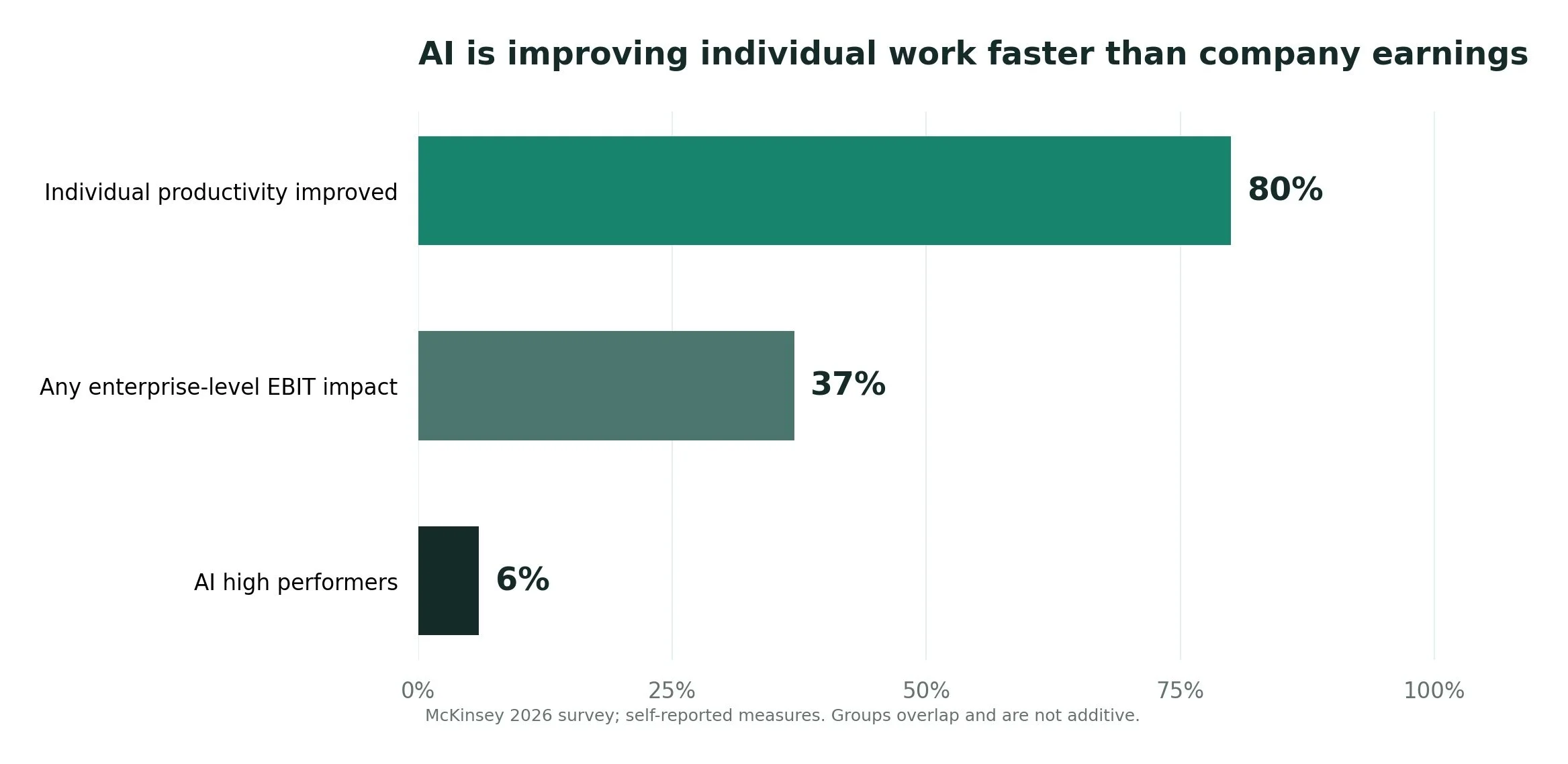
That distinction between individual efficiency and enterprise profitability is fundamental. A company can deploy AI successfully in customer service, forecasting, and marketing and still struggle to demonstrate an improvement in its overall operating income.
The 2026 McKinsey research finds that businesses producing the strongest AI results are more likely to redesign workflows, commit senior leadership, and measure outcomes. The technology isn’t the only differentiator. How the business operates around it matters considerably.
This changes the question. Instead of asking why cannabis is failing while everyone else succeeds, we should ask which AI applications are actually generating returns, and why those returns are difficult to replicate across an entire cannabis business.
2. What cannabis operators are actually reporting
A June 29, 2026 investigation by Alice Moon for mg Magazine, titled “How Cannabis Businesses Are Actually Using AI,” interviewed operators across cultivation, manufacturing, retail, marketing, and technology. The accounts are revealing because they describe actual deployments rather than speculative promises.
Motley Terpz — cultivation and financial planning. CEO Matthew Schneider reported using AI for nutrient-program review, soil analysis, irrigation planning, and cost modeling. He described faster and more efficient work but did not claim directly attributable increases in profit.
Jaunty — demand planning. Chief Revenue Officer Drew Cesario described applying AI to retail reorder forecasting to help avoid out-of-stock situations. The company reported substantial growth without corresponding headcount growth, although the account does not isolate AI’s financial contribution or establish a controlled comparison.
Kaya Bliss — retail customer service. The Brooklyn dispensary deployed a website AI budtender. Marketing executive Daryn SantaMaria acknowledged that the tool sometimes provides incorrect responses and requires additional backend training and coding. That is a genuine implementation limitation, not evidence that the entire project failed.
CannMenus — product-data infrastructure. CEO Vibhav Gupta described a technical problem with direct implications for AI: identical cannabis products can appear under numerous different names across retail menus and POS systems. Until that information is normalized, AI cannot reliably interpret the underlying commercial records.
These interviews show real AI adoption, practical benefits, and meaningful limitations. They do not supply enough financial evidence to conclude that cannabis companies are either outperforming or underperforming the broader market.
There is also a measurement problem here. Avoiding an additional hire, saving managers five hours each week, and preventing a stockout all create potential economic value. But unless the business measures the counterfactual—what would have happened without AI—it cannot confidently attribute that value to the technology.
A company can be obtaining genuine benefits while remaining unable to prove its return on investment.
3. Cannabis has success stories, too—and some have measurable results
A particularly useful example is Happy Cabbage Analytics. Its purchasing platform combines forecasting, inventory analytics, and workflow automation, with AI-supported capabilities. It is important not to credit every result to AI alone.
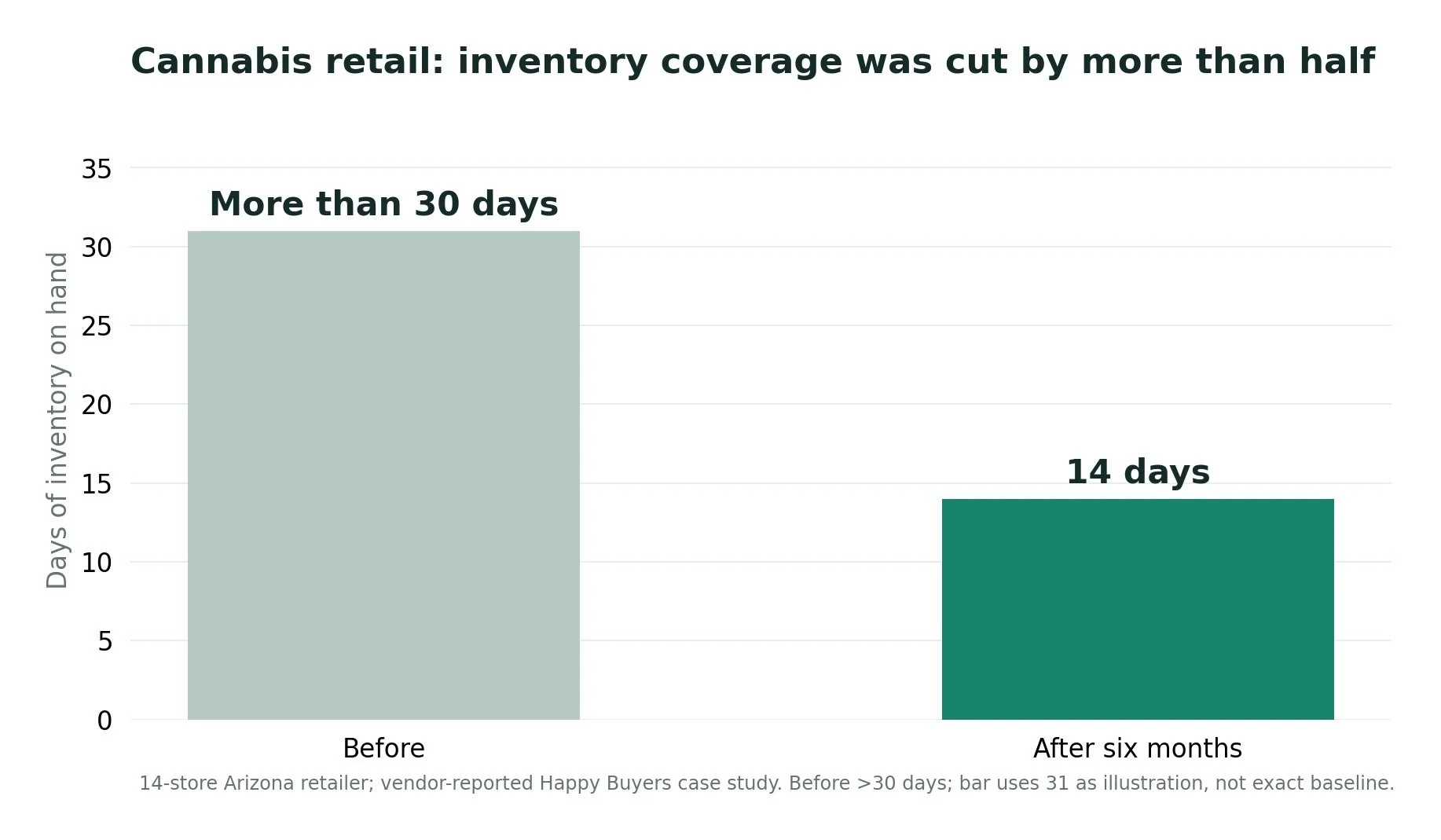
14-store Arizona cannabis retailer — vendor-published case study. After six months using Happy Buyers, the retailer reported reducing inventory from more than 30 days on hand to 14 days across its stores, while saving 8–11 hours per week on purchasing activities. The vendor describes hundreds of thousands of dollars in released working capital.
Redi Cannabis, Massachusetts — named customer case study. Redi reported replacing cumbersome purchasing analysis with automated demand intelligence and a disciplined SKU review process. Its published case study reports a 55% post-discount margin, although that margin cannot be attributed to the software alone.
These accounts are commercially encouraging, but the evidence is vendor-produced rather than independently audited. Still, they demonstrate the important distinction between a credible operational improvement and proof of AI-specific causation.
They also reveal something about successful deployment: the system doesn’t just generate a forecast. It helps a buyer make a purchasing decision inside an established workflow.
That is meaningfully different from giving a retail manager access to a chatbot and expecting margins to improve.
4. What can cannabis learn from industries demonstrating stronger AI outcomes?
Agriculture: John Deere’s See & Spray. Deere reported deployment on more than five million acres during the 2025 season, with customers reducing non-residual herbicide use by nearly 50% on average. Separately, a three-year University of Arkansas field trial reported herbicide reductions of 43–59%, depending on operating conditions.
Financial services: Klarna’s AI assistant. In its SEC filing, Klarna reported that its assistant handled 80% of customer-service chats during 2025 and estimated $39 million in savings during 2024. Those are company-reported measures, but they establish a defined workload, usage volume, and financial estimate.
The comparisons matter because they illustrate two different models of success. Deere’s system identifies weeds and triggers a targeted mechanical action. It operates inside the farmer’s existing equipment and produces an outcome that can be tested against conventional application.
Klarna’s assistant handles a high-volume, comparatively standardized information workflow. It can measure conversations handled, resolution times, repeat contacts, and service costs.
Neither example proves that AI can autonomously manage a cannabis cultivation business. But both demonstrate the value of targeting a clearly defined process where inputs, decisions, actions, and results can be connected.
There is also an important caution in Deere’s research. The Arkansas trial found that using a low-sensitivity setting could produce a substantial increase in the weed seed bank. The technology could save herbicide while worsening another important agronomic outcome.
That is a powerful analogy for cannabis: an AI system optimizing one metric can damage the overall operation if it ignores the system’s other constraints.
A cannabis cultivation algorithm that maximizes yield without accounting for finished-product quality, labor, disease pressure, production costs, or customer demand may deliver exactly what it was told to optimize—and still produce a worse business result.
5. Why cannabis may face additional difficulties
The most persuasive explanations are operational and economic, not that cannabis employees are less capable of adopting technology.
First, the data is fragmented. Cannabis businesses often operate separate systems for environmental monitoring, fertigation, inventory, compliance, POS, wholesale sales, and financial reporting. This creates an integration problem before AI enters the picture. The CannMenus account is direct evidence that even retail product identification can be inconsistent.
Consider a hypothetical cultivation operation. Its environmental system identifies a room by number, its production tracker uses a harvest identifier, the inventory system assigns batch IDs, and its commercial reports group products by SKU. Unless those identifiers are connected, the business may struggle to calculate which cultivation conditions generated its most profitable finished products.
Adding AI does not automatically establish those missing relationships.
Second, biological processes demand context. In September 2025, Fluence published a technical discussion of AI-generated cultivation recommendations. It identified oversimplification of lighting requirements, nutrient programs, cultivar differences, and indoor versus greenhouse environments as recurring limitations of generic AI advice. The article is an industry expert perspective rather than a controlled benchmark, but the underlying distinction is important.
A language model trained on general horticultural information is not equivalent to a validated crop model with actual cultivar, sensor, irrigation, and harvest-performance data.
Third, regulatory fragmentation increases implementation complexity. Reuters documented inconsistent cannabis testing standards across states in April 2025, including different contaminant limits, testing methods, and laboratory practices. A multi-state compliance assistant must work from jurisdiction-specific rules and maintain reliable records of which requirements apply to each operation.
Fourth, many operators have limited investment capacity. Cannabis companies have faced unusually restrictive financing conditions, borrowing costs, and tax treatment. This doesn’t prove that they cause AI projects to fail, but it supports the argument that large-scale implementation can be financially harder to justify.
There is a fifth issue worth examining: operating-system maturity. A business with inconsistent SOPs, unclear decision ownership, unreliable measurements, or disconnected departments has to solve those management problems whether or not it adopts AI.
The 2026 McKinsey findings support the importance of workflow redesign and operational rigor across industries. What remains unproven is whether cannabis companies are systematically worse at these practices than comparable young, regulated, capital-constrained businesses.
6. The critical distinction: AI adoption versus operational transformation
This is where I think the strongest argument lies.
A cannabis company might implement AI in customer communications, employee training, and reporting, generating real efficiency gains. But the largest financial outcomes may depend on decisions crossing multiple departments.
Imagine a vertically integrated operator whose retail sales show growing demand for a premium cultivar. That information could influence its next cultivation plan, genetics allocation, expected harvest volume, post-harvest labor schedule, packaging requirements, and wholesale commitments.
An AI tool that produces a demand forecast has completed only one part of that process.
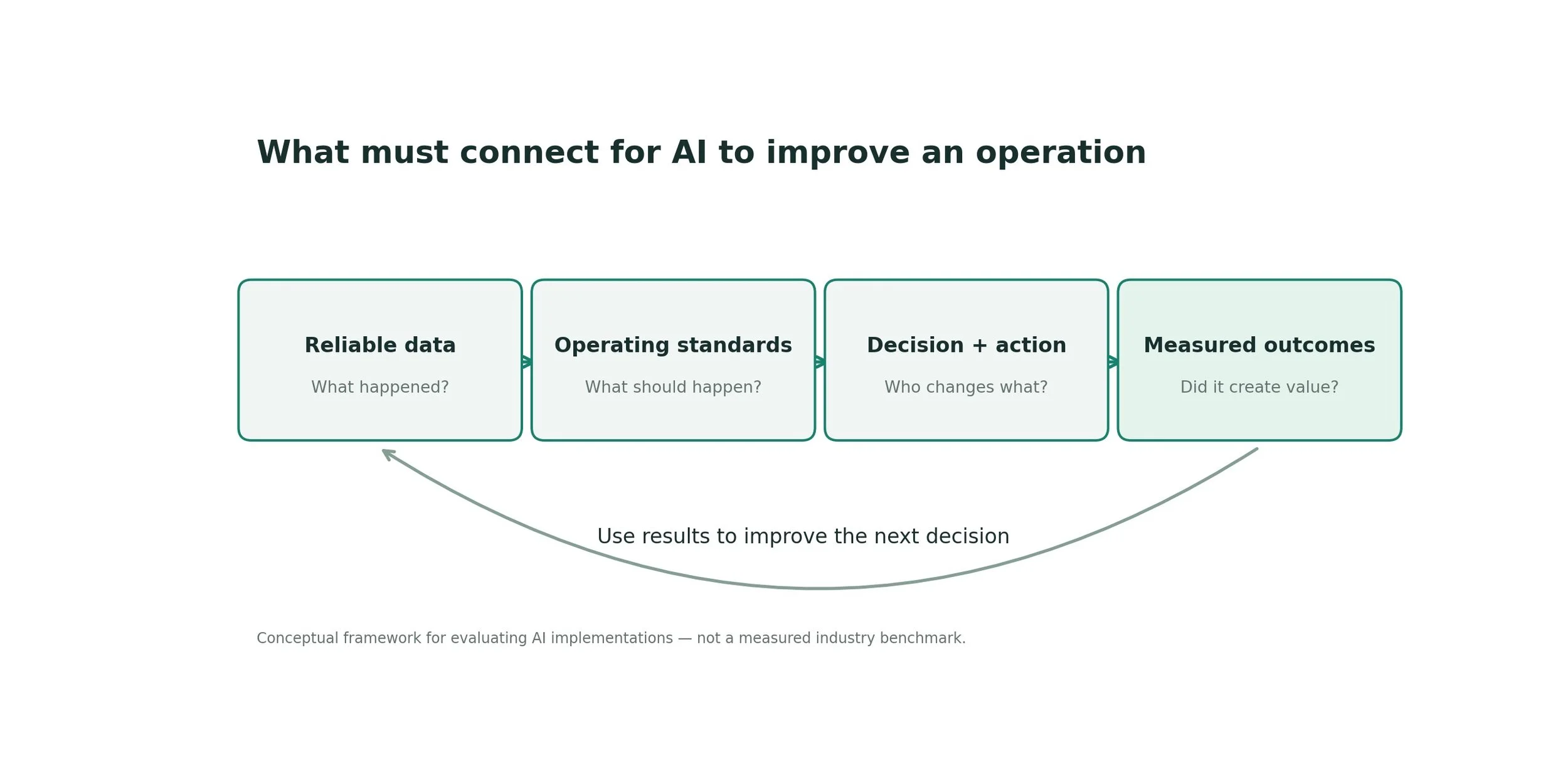
To generate an operational return, someone—or a well-controlled system—must convert that forecast into production decisions, execute the work, measure the final results, and feed those results into the next planning cycle.
This is the difference between AI that provides information and AI embedded in a business process that produces an accountable result.
It does not mean every cannabis company needs one enormous integrated software platform. A focused tool can deliver substantial value, as the purchasing case studies suggest. Integration becomes more valuable when the decisions being optimized genuinely depend on information and actions across multiple functions.
7. What evidence would prove that cannabis is actually falling behind?
This is the gap in the available research. A credible comparison would need matched samples of cannabis operators and businesses in comparable industries, including greenhouse agriculture, food production, regulated manufacturing, and specialty retail.
At minimum, it should compare AI adoption rate, pilot-to-production conversion, realized financial ROI, workflow integration, data quality and system connectivity, and company size and technology budget.
Without those controls, comparing a cannabis cultivator with a multinational bank is not particularly informative. Comparing two similarly sized agricultural businesses, or two multi-location specialty retailers, would be substantially more revealing.
My verdict
I disagree that the evidence currently proves cannabis is uniquely poor at AI. There are documented cannabis use cases producing operational improvements, and most industries still face significant difficulty translating AI adoption into enterprise-level earnings.
I agree that cannabis presents especially interesting obstacles to deeper AI integration. The combination of biological variation, complicated regulations, fragmented systems, and capital constraints makes it harder to move from a useful assistant to an operating capability that reliably improves the business.
And I would challenge one additional assumption: installing an AI tool is not necessarily an AI strategy. The strategic value comes from identifying decisions that matter, establishing reliable inputs, changing how those decisions get executed, and measuring the outcomes.
The question for cannabis executives isn’t simply whether their business uses AI. It is whether their use of AI improves sellable yield, labor productivity, inventory turns, working capital, product quality, or contribution margin.
Those are results an investor, operator, or board can evaluate without being impressed by the technology itself.
The industry doesn’t need to prove it can use AI. It needs to demonstrate where AI creates durable economic value.
Research note
This assessment uses McKinsey’s 2026 cross-industry survey, an SEC filing, university field research, named operator interviews, vendor-published case studies, and regulatory reporting. Sources vary in evidentiary strength. Vendor case studies and executive interviews are not substitutes for independent ROI studies, and available evidence does not establish a cannabis-specific AI failure rate.